Q & A
where does golly ned come from
What does We spread are wings as a new nation
origin of banner day
Whatvdoes it means?
What does "Don't go swimming on a dry riverbed" means?
what does "nothing left but a grease spot" mean?
meaning of "see you when the mud dries"
Where does the baseball phrase "got a bead on it" come from?
Where did the idiom "you nailed it" come from?
What does "Don't go swimming on a dry riverbed" means?
Origin of "sakes alive"....as in "goodness, gracious, sakes alive!"
origin of banner day
Where did goodness gracious sakes alive come frome?
1812 hit a big snag
Scroll down just a bit, the answer is there and all will be revealed.
What country does "can't carry a tune in a bucket" originate from?
As far as I can tell, it's American. It's an impolite way of saying a person is unable to sing/hum/play a simple tune. They could be described as being tone deaf.
We don't need her to search the peanut.
slate
Sorry, can't fathom this. Can you rephrase the question or give me the complete sentence from the place that you found this?
What does the author mean when she says that their plans hit a snag?
The answer to this (it's been asked in the past) is just a short scroll down...
I'm like the foster father. I'm just saying, they respect me in that concert. What does it mean?
I got this totally wrong (below)! A foster father is one who takes on the responsibilities of a father. He acts / functions like a father. In re-reading this, I see he is declaring he's being shown respect--not denied it. How wrong my previous answer was! Sorry.
Well, let's see what we can do with the remark as presented. Apparently someone has been in or has performed at a concert. He or she, the speaker, appears to be saying that the audience doesn't seem to be giving its total respect to his/her performance. The genuine article (the father) (the real thing) would probably get more attention or be better appreciated. I could be totally wrong, but that's how I might interpret this. Knowing the exact situation would help with my deciphering of this. jbs
I'm like the foster father. I'm just saying, they respect me in that concert. What does it mean?
What does it mean by "Oh,my clinker!"
I'm not certain which meaning this refers to. A clinker can be a solid piece -- the residue -- left from a chunk of burned coal. Or, in slang, a mistake or a blunder. Or it can mean a failure. Then again, a clinker in Britain can mean (in slang) something that's just great and wonderful. These are your options. If you would give us the context, we'd be glad to see how it works out in the context of that conversation.
I'm like the foster father. I'm just saying, they respect me in that concert. What does it mean?
I got this totally wrong (below)! A foster father is one who takes on the responsibilities of a father. He acts / functions like a father. In re-reading this, I see he is declaring he's being shown respect--not denied it. How wrong my previous answer was! Sorry.
Well, let's see what we can do with the remark as presented. Apparently someone has been in or has performed at a concert. He or she, the speaker, appears to be saying that the audience doesn't seem to be giving its total respect to his/her performance. The genuine article (the father) (the real thing) would probably get more attention or be better appreciated. I could be totally wrong, but that's how I might interpret this. Knowing the exact situation would help with my deciphering of this. jbs
In 1812 we hit a big snag
Here is what I wrote when someone previously asked about hitting a snag: It means in 1812 we hit a problem. That's what a snag means here. It's a hang-up. In 1812 Napoleon captured Moscow. His plan to conquer Russia hit a snag, however, when the snow and the freezing cold drove him back to France. Tolstoy (War And Peace) wrote of it: "Millions of people went from west to east and slaughtered each other to no purpose, all because one man told them to." That's beginning to sound all too familiar, don't you think!
What's the meaning of "to have many bells to ring"?
Where does the expression - give them a bell - come from?
This is primarily a British idiom, meaning "give them a call on the telephone." Once upon a time telephones had a bell sound that rang to announce an incoming call, rather than the signals etc. now contained in our on-the-go telephones. In Britain someone might say, "Give me a bell on the dog and bone," and that would be what is called Cockney rhyming slang. The meaning is , "Give me a call on the telephone." The Cockneys are the people living in a specific area of central London, known far and wide for their distinctive dialect. They ingeniously play with words to create their rhyming slang. The word cockney once meant a strange egg (as cocks (roosters) do not (of course) lay eggs, but that was many centuries ago -- in the 1300s -- when country folk thought people living in London were an odd bunch of people. If you're curious, here's a link to Cockney rhyming slang >
http://www.cockneyrhymingslang.co.uk/
what does it mean when someone says "Golly neds" ??
I'm going to tackle this one first today as it's the easier one (of the others below).
The word golly is a euphemism for God, as it was not considered proper to refer to God in any way other than in loving terms during worship. So in the 1600's various words were coined in place of God, and gully is one of them. Gosh and Gee are two more. Golly Ned! is a mild expression of surprise. wonder, delight or dismay. "Golly, I just won the lottery!" In golly Ned, Ned is a nickname for the devil, so what people were doing was saying both God and the Devil in a single remark.. Golly Ned, I overslept, I'm going to be late getting to work!"
Is it right to say an individual is good at making an angel out of a stone? what does it mean?
I'm not sure about this one, and I don't want to guess.
what idiom can be used to express the fact that someone is good at creating something wonderful from things others call worthless
I'm going to think about this one.
What does We....spread our wings as a bew nation mean????
Bead
What does we spread our wings as a new nation mean?
Scroll down down down for the answer. This has been asked numerous times.
origin of catch you later?
As far as I can tell, this goes back to the 1950's, a time when there seemed to be a surge of different ways to say "I will see you later." The jazz musicians of that era said "Dig you later." (They also used Dig to mean "I understand.") A favourite of the time was, "I'll see you later, alligator." That rhymed, and it caught on quickly. (Became in use quickly.) Then came a follow-up reply: "In a while, crocodile." Back to catch you: to catch is to get, to receive, as in catch a ball; or to catch a cold (get a cold); to be in contact with. "Do you catch?" (This last remark means, "Do you get it? Do you understand?"
to whom
do I attribute the first use of "give it the old college try"?
The first attribution I find is in a newspaper column dated 1917, later (1919) used in a baseball game when the team manager said his college-graduate player had distinguished himself by performing with his old college try in the game.
It means to do one's level best doing something, especially when the task seems difficult. "We're understaffed but if we give it the old college try we may be able to get the hall decorated in time for tomorrow's dance."
age and origin of "that'll be the day"
Is "to get the skinny" an idiom?
Yes, it is, and it's been so since the mid-1930s in the US. It means 'information' or 'the story.' You might hear or see it in the phrase The straight skinny, which means 'the truth' or the 'complete information.' Examples: "I heard there's going to be a party at your house. What's the skinny? (What's the story? (i.e., what's the information? ) "You said Henry proposed to Frances? Is that the straight skinny?" There's uncertainty about the origins of this so I'm not going to make a guess about it.
let the good times roll?
If you're planning to go to New Orleans during Mardi Gras, it would be a good idea to learn to say let the good times roll in French, for that's where this expression originated. It means 'let's eat, dance, drink, have fun and be happy.' Here it is in French: Laissez les bons temp rouler.
what is a bed swimmer?
I can only imagine: someone who remains in bed for a lengthy period of time; someone who tosses and turns a great deal while sleeping. If I were to be pressed, I go with the one who tosses and turns. As you can tell, this is a new one to me!
what is the origin of thrown to the wolves"?
As you know, someone thrown to the wolves is being sacrificed, perhaps for the good of others, perhaps to get rid of someone disliked. It's found in Aesop's Fables where someone taking care of a couple of unruly children threatens to throw them to the wolves if they don't behave. "When the teacher was looking for someone to punish for making noise, my friends threw me to the wolves by telling her I was the one who had been pounding the table. Actually, we'd all been doing it.
Blow a gasket?
Where does the saying "Give it a whirl" come from?
My guess: from any game of chance in which you spin a wheel (whirl it), as in a casino, a carnival, etc. It means to take a chance, to try doing something. "I've never tried singing on stage, but tonight I'm going to go to a karaoke place and give it a whirl. " Thinking about becoming a writer? Here's pen and paper, give it a whirl."
What does TO LAND WINGS mean
When fishing, to land a fish is to catch one. To land a job is to get a job. Without knowing what this relates to, I'll take a wild guess: An air cadet finally completes his flight training. He could be said to land his wings. That is, he gets his wings-- which in a flying context means he's now able to fly a plane on his own. Beyond that, I would have to see the sentence this is in. "Tony completed his pilot training yesterday and has finally landed his wings."
the door is always open
This page could be considered an example of the door is always open. By that I mean you are free to ask me any question, the door is always open.
No invitation is necessary, there are no restrictions.. "The teacher said her door is always open after class if you have any questions. " "If you have ideas how to make improvements around here, I'm willing to listen. My door is always open to suggestions." the boss said.
got my eye on you
This means to watch someone, to stare at someone. To do that, you use your eyes -- or at least one of them. It's a little confusing because we usually talk about eye, not eyes. But both would be all right, as in "I'm keeping my eyes on you.
is willy-nilly an idioms
I don't think of it as an idiom. In Shakespeare's day it was stated as will he or nill he (or will you, nill you) meaning with or against someone's will. Playing with words like this is known as Reduplication -- a doubling up of sounds to give them a musical feel. Here's William Shakespeare using it in The Taming of the Shrew, which is dated 1596:
Thus in plain terms: your father hath consented
That you shall be my wife; your dowry 'greed on;
And, Will you, nill you, I will marry you.
[that is, I will marry you, whether you like it or not.]
these days i am reading shakespeare
That's wonderful! I wish more people would read him. Here are a couple of sites that might assist in getting an understanding of his works:
http://www.shakespearehigh.com/classroom/guide/page1.shtml
and
http://www.bardweb.net/language.html
I look forward to eventually reading YOUR play! jbs
History of the idiom "banner day"
This means a special day, a wonderful day, and we've been celebrating such occasions since the beginning of time. If the word banner goes back to the 13th century, then it's fair to say we've been having banner days -- raising flags and pennants and waving colourful pieces of cloth to cheer our success-- ever since.
where did the expression "hooting on someone come from"
In Shakespeare's day it was common to shout approval at actors during a performance -- and the same was true about crying out and making sounds of disapproval. Hooting -- that is, whooping and shouting like a jackal -- was part of the jeering. The idiom hoot and hollar says just that: to make noise shouting and yelling. In sum, hooting on someone means to yell at them, though I imagine this could also be interpreted to mean blowing the whistle on someone. That is, to report someone's actions or misdeeds to the authorities.
turn in
Q - where did the phrase to turn in come from
jbs - More research is required here. I'll let you know shortly.
jbs - My research so far: It would seem there is no answer. It's just one of those verbal expressions that, over time, becomes accepted. It may have started in the 1500s -- or it may have started in the late 1600s. Then again, the expression may have been first used in 1700. But if, as is the case, we find it in the writings of those periods, then it stands to reason that it was something understood, just as we understand the meaning of a lost book that turns up, a beggar at the door that you turn away, a silly photo of someone whose toes turn in , of you turning on a radio, or of an addict who turns on (something), or, perhaps, a captured animal that is turned loose in the wild. So it goes, the world turns...
burning platform - this is descriptive, but I don't know of what. More details would help.
Why are cats holy in Holy Cats?
We aren't quite certain why, though some think it's an alternative to saying Holy cow! and we owe that exclamation to Hindus who believe that cows are sacred. In English, both are used and are interchangeable. They express surprise, delight, or astonishment. "Holy cats, I passed my examinations!" "Holy cow, who would have thought!"
Swimming on a dry riverbed
When a river goes dry, all that's left is a riverbed devoid of water. You can't swim in nothing, so this means someone will make no progress whatsoever. He is going nowhere and doing nothing but flopping his arms.
Can't carry a tune in a bucket
where does the expression "can't carry a tune in a bucket" come from?
There's more than a little sarcasm here. A person who can't carry a tune is unable to sing a song in the key in which it was written. I'll post the idiom for you explaining that.
You can carry many things in a bucket, so if it's said someone can't even carry it in a bucket is a harsh way of saying they are totally unable to carry a tune.
What's it mean betting dollars to donuts?
In making a bet, the one who says "I bet you dollars to donuts is saying he's so sure he will win that he would gladly put up a stake of money to a stake of donuts. If he loses, he gives over money. If he loses, he wins donuts. Therefore, he has to be pretty sure of himself. "I bet you dollars to donuts it will rain tomorrow." In the UK, donuts are spelled doughnuts.
Cool
He ran like nobody's business? Why nobody's busness?
It's not known exactly when or how -- or even why -- this expression came about, but it means to do something in an excellent manner, or to do something quickly, or to do it thoroughly. It's done well and perfectly. "My brother can play the piano like nobody's business." "Dion can cook spaghetti like nobody's business. And by the way, she can clean house like nobody's business too. It takes me all day, but she's done with it in an hour. "
origin of "goodness gracious, land sakes alive"
What is the origin of the idiom "pay a visit"?
What is the origin of hit the books?
What is the origin of " caught my eye"
You ask about origins, but who knows where many of our idioms come from. Most can be found to go back a long, long time, and we can only guess what the speakers had in mind. Definitions are another matter, and I'm always glad to help you there. Goodness gracious, (land) sakes alive, for example. Here's what I previously wrote about that: An exclamation of surprise and wonder. It's a bit dated, but it's still nice hearing it. "Oh, look! Goodness gracious sakes alive, there's that handsome guy we saw on television last night!"
pay a visit: we accept that in this phrase pay means to call on someone, to stop in. "My brother paid me a visit yesterday."
hit the books. Again, we accept that hit means to begin doing something, which in this instance is to read. An ice skater might hit the ice, while a football player hits the football pitch. With books, it means to start reading.
catch one's eye You are suddenly alerted to something you see. Your eye (your vision) is "caught" by it. "Fergus was walking alone down the busy street when a galloping horse rushed by catching his eye.
what is the figure of speech in this sentence: Once in a blue moon, we don't get homework.
There actually is an origin to once in a blue moon. On rare occasions a month will have two moons. This occurs once every two or three years on our calendar. From that, something happening every now and then becomes in a blue moon. Why blue? Because sometimes the moon might appear blue to some people at some time on some days while in some position in the sky. Once again, it's a question of origins: someone thought the moon looked blue, and because it was a rare moon,...well, that's the way it is with idioms. Forever after, it is once in a blue moon -- and in the sentence you present, it's a rare occasion when the class does not get a homework assignment.
billy bargain
It means nothing. It's a business name.
What is the origin of stick together?
Stick (v. intr.) has the meaning of being faithful, enduring, being loyal, remaining constant. So it's understandable that lovers, friends, people in a family stick together, whether in times of love or during a time of hardship. And I definitely and positively stick by that explanation.
What is the history/origin for: Got my eye on you?
From the verb to eye, eyed, eyeing/eying = to watch carefully, to look at closely,
to study (with the eyes), to fix the eyes on. Origin? Way, way back in time. /
what is the idiom of the sentence ''If you ask me, my grandmother has eyes in the back of her head
It's not just grandmothers's who have eyes in the back of the head. Teachers do, too. And your boss certainly has. In fact, if you look around you you will probably find that anyone who's checking on you, observing you (for whatever reason), or "keeping an eye on you " (see above) has eyes in the back of his/her head. It's a way of saying someone senses what you are doing or knows pretty well what's going on around them. Remember what I said about teachers and bosses and you'll never go wrong by doing wrong.
nice
spread our wings as a new nation
what do these two idioms mean? we spread our wings as a new nation
WE SPREAD OUR WINGS AS A NEW NATION what does that mean
Judging from the number of times this question has been asked, I'm of the opinion that this remark appears on a test or in a text somewhere. Fortunately, my answer today is the same as it was before. And the answer is... >
When baby birds reach a certain stage of development, they flap their wings as they think about flying. And then, finally spreading them, they jump from the nest. Wheeeee, they have gained the confidence to set out on their own and to be independent. They have shown a willingness to try new things and assert themselves. That's what is meant by spread one's wings, and it's but a small step (to mix metaphors) to imagine what is meant when a new nation spreads its wings. If you have the exact place where this appears, and in which phrase, we'd be happy if you'd share it with us. Thanks, jbs
in 1812 we hit a big snag
Here is what I wrote when someone previously asked about hitting a snag:
It means in 1812 we hit a problem. That's what a snag means here. It's a hang-up. In 1812 Napoleon captured Moscow. His plan to conquer Russia hit a snag, however, when the snow and the freezing cold drove him back to France. Tolstoy (War And Peace) wrote of it: "Millions of people went from west to east and slaughtered each other to no purpose, all because one man told them to." That's beginning to sound all too familiar, don't you think!
let ideas incubate
To incubate is to keep warm (as a mother hen keeps her eggs warm) until ready to develop. In fact, hens are said to incubate their eggs. From that, you can see that if you have an idea that's not entirely formed, the best thing to do is to sit on it (wait) a while. Let the idea form or develop in its entirety. Then act. "Bell had an idea. He'd like to have something that would allow him to transmit his voice so his deaf wife could hear. Not sure of himself, he let the idea incubate until he eventually devised such a contraption. In time, of course, his invention would be known as a telephone."
NOTE OF DISCLOSURE: Alexander Graham Bell was my great, great uncle, and yes, his wife was deaf and no, he did not set out to invent the telephone. He wanted, as he said, to create an instrument "to conquer his wife's silence." In effect, he wanted to make a hearing aid.
what does this idiom mean i only asked one friend to help me build the boat
It doesn't seem that we have an idiom here. What we have is someone building a boat with a friend, and only one friend, not a whole bunch of friends. I'm curious to know what kind of boat that would be. A sail boat? A row boat? Perhaps it's just a toy boat they can sail in the bathtub.
where did the phrase to turn in come from
More research is required here. I'll let you know shortly.
My research so far: It would seem there is no answer. It's just one of those verbal expressions that, over time, becomes accepted. It may have started in the 1500s -- or it may have started in the late 1600s. Then again, the expression may have been first used in 1700. But if, as is the case, we find it in the writings of those periods, then it stands to reason that it was something understood, just as we understand the meaning of a lost book that turns up, a beggar at the door that you turn away, a silly photo of someone whose toes turn in , of you turning on a radio, or of an addict who turns on (something), or, perhaps, a captured animal that is turned loose in the wild. So it goes, the world turns...
get a bead on
Get a bead on something. This can be said as have a bead, get a bead, or draw a bead. They all mean the same thing: to have something or someone as one's objective. A bead is a small raised spot (it might even look like a bead) at the end of a gun barrel that is used when aiming. The person aims at a target by pointing the bead at it. But this idiom is used to indicate having something in one's sight. "I have a bead on that pretty girl in my class with the lovely eyes." "He drew a bead on a future in television even as a young boy.
believe you me. Is it from French?
You frequently find this kind of construction --verb-subject-object-- in the King James version of the Bible because at one time such constructions were acceptable in Early Modern English. It's not French, it just looks that way. It's an emphatic -- and acceptable -- way of saying believe me you.
If one of us grandkids made a loud noise (i.e. fell on floor), my German grandma would yell, "Did somebody make a grease spot in there?" Where did that saying come from? Is it German or English? A literal English translation of a German idiom?
This is an old expression, not necessarily German. I'm going to research it further, but it would seem that your Grandmother was pretty sharp to pick this one up. In German it would be "einen fettfleck" (a fat spot) so it's not likely something your Grandmother brought from Germany. What she was alluding to (as a joke) was that from the sound of it, it would appear that someone had just been killed -- and there was nothing left of that person except a grease spot on the floor. Your Grandmother had a great sense of humour!
The nose knows These two words sound alike, but have different meanings. At the same time, it states a truism. We determine many things by taste and many things by smell. If we are blindfolded and someone has us smell a rose, we will be able to determine that it is a nose because the nose knows. So it's a play on words, but it makes all the sense in the world.
what is the origin of the proverb get down to nuts and bolts. When putting something together, the basic parts may very well be its nuts and its bolts. As in a robot, for instance. So this, as you know, means to get to the basics. The same thing is expressed as getting to the nitty-gritty and getting down to brass tacks.
The origin? We just don't know.
Goodness gracious sakes alive An exclamation of surprise and wonder. It's a bit dated, but it's still nice hearing it. "Oh, look! Goodness gracious sakes alive, there's that handsome guy we saw on television last night!"
to chip in? & a clip joint. To chip in is to help by contributing something. It's generally used with respect to money, but it can also be used to describe helping out physically. "We're buying a gift for Nell, so let's all chip in so we can buy her something nice." "Danny was sick and didn't come to work today so I chipped in and helped to do his job."
Quick as Jack Robinson?
This just means fast. It's origin is uncertain, but it's been recorded as early as the late 1700s. It's also expressed as before you can say Jack Robinson. Jack Robinson was a common name in 18th century England. "I saw a huge bear in the woods, but quick as you can say Jack Robinson, it vanished." "I'll put several cup cakes on the table, but you'd better be quick as Jack Robinson or they'll soon be gone."
What's the origin of "two can play at that game"?
If someone does something you disapprove of, if an enemy uses a tactic against you, or if in a contest a person uses a trick in an attempt to defeat you, you can do the same to them using a similar method. Their scheme or trick or method is the "game" referred to here. "The enemy plans a surprise attack at dawn. Well, two can play at that game, we'll attack them just after midnight." It's from the French: deux peuvent jour a ce jeu.
Sakes aluve
You mean sakes alive! It's an exclamation, sometimes of surprise. "Sakes alive, what's Johnny doing up a tree?" "You must be more careful crossing the street. Sakes alive, a car could hit you!"
on the money and dead certain?
This means correct, exactly right. It's probably from horse racing. If you bet on a horse and it won, you got money. It's often expressed as right on the money. "The weatherman's prediction of rain was on the money, look at it coming down!"
dead certain
Absolutely certain. No doubt about it. "The weatherman said he was dead certain it was going to rain today." "I'm dead certain I heard an owl outside my window last night."
What is the meaning of dry riverbanks? Which type of figure of speech is this?
Rivers have banks, one on either side. When the level of the river falls, the banks are dry and exposed. In the deserts of the American west, you see many dry riverbanks. Nothing in the river at all. Then it rains, and suddenly the rivers are flowing again. Soon the water vanishes again, leaving dry riverbanks.
That's about all there is to understanding dry riverbanks.
The source of the "Gravy" idiom is comments from Cardinal Dolan about the new Pope Francis and a question from an English language teacher in Argentina about the idiom.
[Cardinal Dolan said in an interview after the conclave that "Catholic is part of their DNA" in Argentina. With Cardinal Bergoglio as pope, he said, "think of the electricity that is going to send."
But he said that country of origin was not the main factor for the cardinals who elected him.
"Most cardinals just want to choose the right man," he said. The pope should be a good pastor, governor and communicator. "He fills those bills. Where he comes from is gravy. And we've got a lot of good gravy."
"He fills the bills." is clear, but the "gravy" not so clear.
Thanks.
Where he comes from is gravy.
I'll need something more to figure this one out. Can you give me the exact sentence?
Ahh, I think I've got it...and thanks for taking the time to elaborate the question for me. In slang, "gravy" means something extra, something unexpected. On top of everything, it's an added bonus. So, we see that the new man selected to be Pope has a number of good points in his favour, and in addition, where he comes from, being Catholic is said to be part of everyone's DNA. That's the "gravy" referred to.
WHAT IS THE MEANING OF: NOT WORTH BEING NAUGHTY FOR
Let's assume that being naughty means doing something not quite moral or legal. In other words, something a little bit risqué or spicy. Or even something a little wrong. Now Eddie might say, "I'd like to skip school today, but if I got caught I'd be punished. So the little pleasure I'd get from skipping school isn't worth being naughty for." That's Eddie's experience. You could probably write your own, yes?
bone honest
Absolutely, totally honest.
In A Tizzy?
To be excited, worried, or confused. Can be expressed as in a tizzy, get into a tizzy, thrown into a tizzy. "The change in our work schedule has me in a tizzy." "It's thrown me into a tizzy too." "Don't get into a tizzy, we'll soon get used to it."
what does "in the 11th hour" means?
The 11th hour / the eleventh hour means at the last possible moment. Think of a clock, and think of an hour before it strikes midnight. That's the 11th hour. "The school dance was cancelled at the 11th hour, just before the tickets were printed and a band was hired."
"I thought no school had accepted me, but at the 11th hour I got a call from the one I really wanted to attend. "
what idiom can be used for "to spread light while fire"
give me a sentence for this idiom "to spread light while fire"
what does "to spread light while fire" means?
I think this is an analogy. A wildfire is a fire that spreads rapidly – and you only have to think of the recent fires in Australia to know what I mean by that. There's an expression, spreads like wildfire, meaning something that moves quickly. " That new computer virus has spread like wildfire. Everyone's in danger of being infected."
But perhaps this isn't what you're after. If that's true, there's no idiom or expression of any kind matching what you've presented. Is it possible you heard or read it wrong?
to teach a child manners while it's still young This isn' t an idiom, merely a suggestion about when to teach manners.
get a bead on it
Get a bead on something. This can be said as have a bead, get a bead, or draw a bead. They all mean the same thing: to have something or someone as one's objective. A bead is a small raised spot (it might even look like a bead) at the end of a gun barrel that is used when aiming. The person aims at a target by pointing the bead at it. But this idiom is used to indicate having something in one's sight. "I have a bead on that pretty girl in my class with the lovely eyes." "He drew a bead on a future in television even as a young boy.
If you buy a bike for him you will pay through the nose
You will pay a great deal of money for it. The bike is costly.
shot to hell
Answer: Shot is a contemporary way of saying something is worthless. Ruined. Destroyed . "My car's shot. I can't even get it started." -- Shot to hell merely adds emphasis. It's descriptive. "My car's no good, the motor's shot to hell" You might also use this to say you're exhausted. "I can't play tennis . I'm tired. I feel really shot to hell today."
what idiom can be used for 'a little far away'?
Here are a few ways of saying something is nearby:
at close range
close by
close in
close to home
* (this doesn't necessarily refer to one's home: it can also refer to
something that affects one personally. Example: Joe's talk about people being laid off hit close to home. I'm worried it could happen to me."
close at hand
near at hand
within arm's reach
What's two a penny mean?
If it's two-a-penny it's plentiful or cheap. "It wasn't long ago that flash drives were expensive, but today they're two-a-penny."
And also, gobbledegook.
Language that's convoluted, mixed up, hard to understand, a bit of a mess. Or at least it seems that way. It's difficult to understand. "I have to file an insurance claim, but I can't understand my policy. It's all a bunch of gobbledygook. " This is sometimes written as gobbledygoo," which is a a play on the way a baby might talk: Goo, goo, goo...etc.
origin of watching paint dry
I can't find the origin, but it's probably from the 1960s. It means something is extremely boring. "To me, watching a game of cricket is like watching paint dry."
Itsie-bitsie??
This means very small. It's probably a play on the words little bit, and is spelled all sorts of ways, including itsy-bitsy. Teeny-weeny means the same thing, as does teensy-weensy. There was a song in 1960 describing a bikini bathing suit worn by a girl: "She wore an itsy-bitsy, teeny-weeny yellow polka dot bikini..." and so forth. Since then, the young lady in the bikini would be in her late 60s or early 70s, in which case the yellow polka dot bikini probalby would no longer fit her. But I could be wrong...
By the way, I note you can Google "Yellow Poka Dot Bikini" and hear the song. Give it a spin, as they used to say way back then! I'll make it easy for you, here's the site: http://www.youtube.com/watch?v=ICkWjdQuK7Q
the origin and explaining the meaning of the expression "time flies". Include
Virgil, a Roman poet. About 50 BC. He wrote Tempus fugit in a poem , which means time flees. The Latin inscription appears on sundials and sunclocks throughout Europe to remind us that time is passing by quickly. Therefore, we should be aware of that and use time wisely.
what do 3 nickel bells have to do with Christmas Nickel bells are bells made of nickel or nickel plated. The only thing the have to do with Christmas is that you can ring a bell made of nickel or plated with nickel at Christmas. Or New Years. Or on your birthday. So it's descriptive, nothing more.
Where does beforehand come from
If something is at hand, it is available now. You can reach out with your hand (physically or metaphorically) and touch it. If it's before+hand, it was there at the start, or in advance, or previously.
have at it
This is the same as saying go do it, or give it a try. "I'm feeling so good, I could probably climb Mount Everest today." Buster said. "Have at it, his lovely wife answered with a smile on her face. "There's an opening at the bank for someone with my qualifications. I think I'll have at it" Ken said.
Can you tell me what fair dinkum is?
This is Australian. It means "real" or "genuine". "Is it true Billy's getting married?" "Tommy told me it's fair dinkum."
There's another dinkum lurking in Australia, and that's hard dinkum This one means "hard work". "Bing's studying for his examinations. Getting through med school sure takes a lot of hard dinkum." "
And fair to middlin?
It should be middling, a word meaning middle or moderate (of quality, size, feeling, degree). The expression you ask about, fair to middling , can mean "not bad," "so-so," or "not super, but better than average." Examples: "How do I feel today? Oh, fair to middling, I guess." "I only did a fair to middling job cutting my own hair." "If you're walking, it's a long way to Oxford, but I'd say the distance from here to Banbury is fair to middling." "My apple crop is only fair to middling this year," farmer Kirby said.
what does "He has quite a few baseball cards" mean?
Here's Wikipedia's page on and about baseball cards. The term does not apply to cards shaped like baseballs, nor to baseballs shaped like cards. Have a look> http://en.wikipedia.org/wiki/Baseball_card
hang game to dry Sorry, not an idiom. It's an instruction (If I have this right) to hang a game animal up to dry. You can read all about it, and see a photo, at this site:
http://honest-food.net/2012/10/20/on-hanging-pheasants-2/
what does "don't go swimming in a dry river bed" means? It sounds to me like a bit of dry wisdom. Of course you can't go swimming in a dry river.
How this projector can be used while swimming?
Sorry, I've no idea what this means. The only projector that comes to mind is a motion picture projector, and it's not likely that would be used while swimming. Unless, of course, someone out of the water is is operating it. Give me the context for this, please.
"get the key at the table with a blue covered book and a bottle of water"
It seems straightforward enough: the table with the blue book and a bottle of water on it is where you'll find the key.
anyone know what this means? someone told me this and i can't understand what it means
Ringing the changes
To do something in a different way, often to make it more appealing or interesting. This is from ringing church bells, the 'changes' referring to the set of bells being rung in a different sequence to change the tune or melody. "Fashion designers are looking forward to the autumn season when they can ring the changes with their latest designs."
Give a hoot??
To have no interest, to care not. The hoot here (it's Scottish) means a small amount. This is usually said as "I don't give a hoot, " or "Who gives a hoot?" Or even "No one gives a hoot." "I wasn't invited to Beth's party, but who gives a hoot? I sure don't!"
step on your toes
To step on someone's toes is to offend someone by doing something they normally do. At a job, for instance, to respond to someone else's telephone calls would certainly be an offensive act. You would be stepping on their toes. Or to go over someone's head by doing something that's really their job. "It's Joan's duty to arrange the office floral display, and even though I think I can do a better job of it I'm not going to step on her toes and do it."
knock it out of the ball park
This is from the game of baseball. A person hitting a ball so hard that it flies out of the park has done exceptionally well. It's what everyone goes to a game to see. As a metaphor, it means to do very well at something. "The crowd thought the president really hit the ball out of the ballpark when he spoke of working to improve everyone's living standard."
cut a rug
No matter where we are or what we're doing, if we feel like dancing all we have to do is turn on a radio. However, in the 1920's radios and phonographs were brand new inventions, and instead of going out to a nightclub people found they could turn on their radios or wind up their phonographs and dance at home. And at home, of course, there would be rugs on the floors. Dancing on one was likely to cut it up or shred it. Even though they'd usually roll a rug out of the way, they took to speaking of the act of dancing as cutting a rug. Even today, it means to dance. "Hey, Sparky's having a party tonight. Want to go with me to his house and cut a rug?"
Jacked in
Cords or lines to earphones, to radios, CD players etc. have phone jacks. That's the plug, and we plug in to make a connection. Said another way, we jack in. So it is in this modern world that one thing leads to another, thus when we are busy at work (for instance) we are jacked in . We are hooked up. So it goes.
Goodness gracious sakes alive! historical origin/meaning?
The uttering of oaths has a changing history. The ancient Greeks and Romans (in the pre-Christian era) thought it was appropriate – and often necessary – to call out in despair or to summon help by citing the name of a god or goddess. While calling out the name of a god after hitting one's thumb with a hammer might make a person feel better, in the early 1400s religious folk began to disapprove. They believed the words God, Lord and Christ were too sacred to be uttered in a non-religious way, and since we went on banging our thumbs we had to find another way of expressing ourselves. Since it was agreed that God was both good and gracious, those became substitute words. "Goodness, gracious, I hit my thumb with a hammer!" "Goodness me, I forgot Dion's birthday!" "Oh, gracious, where's Jill? She's late again!"
tries and turns where does this saying come from
I don't find this as an idiom. It seems to be someone's way of expressing him/her self.
Where does saying "good darts" come from
From the game of darts. You score well, someone cheers you. They call out "good darts". And that's about the extent of it. Not an idiom, however.
whats the saying as high as There has to be more to this. Such as high as a mountain, high as a kite (someone intoxicated or on drugs).
In my family there used to be a phrase "go chase yourself up a tree." I think I know what it means but could you share your insight on it, if any.
My first insight is that you have a clever family. My second one is that they are telling you to go away. Or they could be shrugging off something you said. This probably has the same meaning as get lost!
what does the expression "in a nutshell" mean?
This means to say something concisely. To sum it up using just a few words. This goes back a long, long way – all the way back to the lst century B.C. when the Roman politician/philosopher Cicero remarked that someone had copied all 24 books of Homer's epic poem The Iliad in writing so tiny that the entire thing could fit into a single walnut shell. That led to the saying, "The Iliad in a nutshell," which comes to us today as in a nutshell. "I can't remember all he said, but in a nutshell, he told me how much he enjoyed his trip to Singapore."
where does ready as a calf come from?
There's no such idiom, no such proverb. My search turns up nothing whatsoever. Sorry
I've posted something. Please read the Blog. JBS
What does the phrase "working it" mean?
Usually this would mean to be doing something. To be working. Those who lift weights are working it. and so too is a taxi driver busy on his shift. But it's possible there's more to this, something contemporary. I'll see what I can turn up.
I'm not worth a plugges nickel
Almost from the beginning of time, counterfeiters have been busy manufacturing false coins, often by removing some of the good metal from them and replacing it with an inferior or cheap grade metal. It was said the coins were 'plugged,' which may or may not be the reason that a worthless or inferior horse in the 17th century was called 'a plug horse'. Much later, and in the US, a small coin made partly of nickel and valued at five cents was known as 'a nickel.' Once again, there were counterfeiters who busied themselves making fake nickels, and naturally they were inferior, and of course they were worthless, which is why they were soon termed plugged nickels'. That gave birth to the idiom, not worth a plugged nickel, and I can see you have already guessed that it refers to something worthless. "This darn camera, I don't like it! It's not worth a plugged nickel." "So the Godfather said, 'Obey me, or your life ain't worth a plugged nickel.'"
The idiom "We spread our wings as a new nation." is found in the story of Francis Scott Key and how he came to write the "Star Spangled Banner." Also the same story asks the meaning of "in 1812 we hit an big snag." Now do you have another meaning for these two idioms?
1812 we hit a big sang. what does it mean?
Here is what I wrote when someone previously asked about hitting a snag:
It means in 1812 we hit a problem. That's what a snag means here. It's a hang-up. In 1812 Napoleon captured Moscow. His plan to conquer Russia hit a snag, however, when the snow and the freezing cold drove him back to France. Tolstoy (War And Peace) wrote of it: "Millions of people went from west to east and slaughtered each other to no purpose, all because one man told them to." That's beginning to sound all too familiar, don't you think!
hell freezes over?
It is said that hell is fiery and hot. That's someone's guess, of course. Accepting that it is, it isn't likely to ever have ice anywhere. This, therefore, is a bit of sarcasm, as in these examples: "Billy asked me for a date, and I said sure, when hell freezes over." " I asked Bob for a loan so I could buy a car and assured me he'd give me a million dollars the day hell freezes over.
what does peanut gallery mean ?
Scroll down, scroll down -- and all will be answered!
swimming in apples
Descriptive.
Examples: Luke won the lottery. He's swimming in riches now.
John's swimming in work.-- etc.
As I said, merely descriptive.
Why do we say something is earmarked? why earmark?
The dictionary meaning of earmark is ' to mark in a distinguishing manner,' which is what was physically done to sheep, starting in the 16th century. Much for the same reason that branding is done to cows with a hot iron, a cut or notch was made on the ear of each sheep so the farmer could tell which were his. It also helped him to identify one if, as was often the case, someone stole it. That's still done to animals, though when we say something is earmarked it's because it, too, has an identifying feature. "The money in our club's treasury has been earmarked to take care of any building repairs." "The county council has decided not to earmark any new land for walking trails." "The UN has earmarked whales as a threatened species."
i found to spread ou wings as a new nation in a pece of paper our teacher gave us
This question is frequently asked. I've been told that it appears as a remark in an examination paper. The answer -- please look for it -- can be found by scrolling down...
Where the rubber meets the road??
There's some uncertainty about the origin of this, but it's assumed that it's American. Apparently it was used in a television commercial for automobile tires in the 60's and 70s, meaning that you can praise your car or your driving aiblities all you want but when getting into your car, the important part of your car are it's tires -- and they'd better be good! Tires, then, are the rubber things mentioned here. This image is now enlarged to include just about anything of importance, as in this example: "Janet says she's a good cook, but where the rubber meets the road is in the kitchen, and I've yet to sample one of her meals."
no comment from the peanut gallery?
Long before we had movie theatres and long before we had television, people actually went out of their homes to be entertained. In Britain they went to what were called music halls to watch jugglers, dancers, singers and performances by comedians. The same type of variety shows in the US were staged in what were called vaudeville theatres, and just as popcorn is the favourite snack at the cinema today, eating peanuts was the snack of choice at music halls and vaudeville theatres. The refined folks had the best seats close to the stage, while the cheap seats were high up in the balcony. Crowds up there could often be loud and rowdy, and when something in the performance displeased them they threw their peanut shells onto those below. The advent of motion pictures pretty much put an end to the music hall and to vaudeville, but the term peanut gallery lingers on. It used to refer to a crowd of ordinary folks whose opinions weren't considered important, though I note that in our electronic age it has come to mean people in a social network audience who watch but don't participate in chat rooms, forums, etc. They are, in fact, silent watchers, which is the absolute opposite of the original meaning of the peanut gallery.
Get my drift?
what do these two idioms mean? we spread our wings as a new nation
WE SPREAD OUR WINGS AS A NEW NATION what does that mean
Judging from the number of times this question has been asked, I'm of the opinion that this remark appears on a test or in a text somewhere. Fortunately, my answer today is the same as it was before. And the answer is... >
When baby birds reach a certain stage of development, they flap their wings as they think about flying. And then, finally spreading them, they jump from the nest. Wheeeee, they have gained the confidence to set out on their own and to be independent. They have shown a willingness to try new things and assert themselves. That's what is meant by spread one's wings, and it's but a small step (to mix metaphors) to imagine what is meant when a new nation spreads its wings. If you have the exact place where this appears, and in which phrase, we'd be happy if you'd share it with us. Thanks, jbs
Poor as a mouse in church?
What you have in mind is the idiom poor as a church mouse. Unlike a mouse living in a house, a mouse living in a church isn't likely to find any food. As it is necessary to have money to have food, this mouse would very likely be a thin and hungry mouse -- and very poor. So poor as a church mouse means to be quite poor. Here's a hard-to-believe example. "He was poor as a church mouse living in a cold attic and sleeping on the floor, but the sale of his novel to Hollywood made him fabuously rich overnight."
What is wig out? thanks.
Wig out began as a slang expression within the American jazz community (circa 1940) where a wig was an eccentric or perhaps even crazy person. That gave birth to the verb to wig , meaning to become excited or to act a bit crazy. Subsequent generations – notably young people that were called Beatniks -- picked it up to describe being very impressed or excited. "Last night's sunset wigged me out." "This new Beatles' record "wigs me out." Along came the next generation, the Hippies, and they used the words to describe someone who, because of the misuse of drugs, had lost contact with reality. ""There were paramedics at the rock concert to treat any spectators who wigged out." To simplify, this can mean to be delighted or excited -- or it can describe being removed from reality due to the influence of drugs.
If anyone can share me a meaning of treat two ways road as one way. Thank you very much.
I'm not sure of this. Can one of our readers help out?
where is this book available?
You can go to AMAZON.COM
or try this link: http://www.amazon.com/s/ref=nb_sb_noss?url=search-alias%3Dstripbooks&field-keywords=Smithback&x=17&y=25
to muck up
To make a mess of something, especially by doing it improperly. "The last time Tim worked on my computer he really mucked it up.
Take the micky out of?
To tease of make fun of someone. This is strictly British. Most people in the US wouldn't have any idea what it means. "My friends took the mickey out of me when I went to Jill's halloween party dressed like a cowboy."
My Aunt said she may not have a car so she'll 'have to shine her pony'
Said with humour, I'm sure. If the aunt had a car, she'd polish and wax it. Not having one...well, you can see her joke.
what is the meaning of don't (go) swimming on a dry river bed?
It sounds as though this means you must prepare yourself before doing something...such as putting water in the river before swimming in it. Like the above comment, this seems to have a bit of humour attached to it.
You are toast?? Why toast?
This is a clever (?) way of saying that you are in trouble. Someone said it once (perhaps on television) so it's now become a popular, much-used, expression.
"You take my books and you're toast!" "If I don't get work on time I'll be toast."
.
What does I have a bead on it mean?
Scroll down just a bit and you'll find the answer >>
SNAKE-OIL MERCHANT In certain cultures and at different times there has been a belief that the oil from snakes possess certain magical qualities. Those with a personal interest in making money invent numerous claims about such an oil, and they put various liquids into a bottle to sell to those willing to believe them. Such promoters are called snake-oil merchants , and what they sell may or may not actually contain the oil of a snake. Because there is no way of proving that their bottled stuff will prevent blindness, grow hair on the bald, increase one's intelligence, restore a man's potency – to name but a few things their snake oil is promised to do – the promoters of these products -- snake-oil merchants -- are universally thought to be quacks, phoneys, con men, frauds, and charlatans. From that, someone promoting a product or an idea or a principle that others disagree with or think of as bad, false or unattainable are referred to as snake-oil merchants. I invite you to look at this page
http://www.google.com/search?q=%22Snake-oil+%22&hl=en&prmd=ivns&tbm=isch&tbo=u&source=univ&sa=X&ei=djCrTeeWH4GmsQPNsen5DA&ved=0CDYQsAQ&biw=1276&bih=788
to see some of the crazy promotions these merchants have created.
Sorry, I forgot my e-mail: mmmvv1@hotmail.nl.
Again thanks.
Dear Sir / Madam. I'm looking for the exact meaning of the phrase "out on it!" I've seen explanations as "shame on you", but that isn't right in the context. The context is: Ebenezer was adamant. "Out on it, then!" his father cried at last. "Wed the whore a second time when our case is won, and be damned!"
Maybe in Dutch "voor de dag er mee!"; this is in English "out with it!"
Thank you in advance.
Machiel van Veen.
Amsterdam.
The Netherlands.
Hello Machiel -
From what little research I've been able to do, out on it appears to be a somewhat archaic British expression, perhaps regional, and in the context you give me I believe it's said as an indication of resignation: "Well, so be it, get on with it then!"
I'm not sure about the Dutch translation you suggest. My translator gives me "for the day." That's not the way I read the comment.
I'm going to post this answer on our internet site as I'm certain your question has piqued the curiosity of others...
Thanks. John
THAT'S RICH
That's rich has two meanings, one old and one new. The old one was a remark used to remind someone that they were being critical of someone for something they themselves were guilty of. "Maggie complains that no one has decent manners anymore. That's rich! Have you seen how she behaves when she goes shopping?"
The second (new) meaning is the same as saying "That's great!," "That's wonderful!," or "That's cool!" "Sadie is going to go to the UK to study. I think that's rich!"
What's it mean when someone who is an apple polisher?
To apple polish / An apple-polisher: A student wishing to please a teacher might present him or her with an apple that he or she has rubbed and rubbed until it has a perfect shine. Sometimes a student does that to win favour or to attract attention so he or she can receive special treatment in return.
That's the origin of this term. "The new worker looks like an apple-polisher. Look, she's bringing home-made cakes for the boss!" "Why don't we do a little apple-polishing ourselves and bring the boss some chocolates?"
have you been asked 'get down to brass tacks'?
Snug as a bug?
We have Benjamin Franklin to thank for this remark. He compared being warm and comfortable to a bug living snugly in a rug. Snug means to fit closely and comfortably. I don't think old Ben actually had bugs living in his rug, but because bug and snug rhyme, he thought the words go nicely together. "It's cold out but I'm snug as a bug in a rug indoors by the fire." "I've put the children to bed," mother said. "They're snug as a couple of bugs in a rug and went right to sleep," she smiled.
Yeah, and cute as a bug's ear?
Bugs don't have ears. That doesn't matter, because this is a way of saying a person (usually a young one) is quite cute. "Betsy's child is cute as a bug's ear, don't you agree?"
A clean slate. Why a clean one? Why slate?
Years ago children went to school carrying small slate tablets ( pieces of blackboard stone) and chalk, and on them they would write lessons, do mathematical calculations, and make notes. They also carried pieces of felt to erase their work. They began their day with a clean slate, (meaning there was nothing on their little blackboards) and at the end of their studies they would wipe their slates clean) -- meaning they would remove everything from them. Today, to begin or start with a clean slate is to begin something anew by putting previous things behind you. "I had a terrible day at the office yesterday, but today I'm going to start with a clean slate by not even thinking about it." As you can see, the speaker has decided to wipe his slate clean by not referring to his previous problems.
I heard this on tv: you nailed it.
This is a recent expression, meaning "You have done it exactly right." Probably a takeoff from the older "Hit the nail on the head."
What does fit as a fiddle mean?
This expression goes back to the time of Shakespeare. He didn't use it in his writings, but those around him probably did. It describes being in the best possible physical condition. Why a fiddle (a violin)? Because a fiddle wouldn't sound well if it was not in the best condition. Also, the words, fit and fiddle (both beginning with the letter F ) go nicely together. That's known as 'alliteration.' (That's a good word - go look it up!) "I was ill yesterday, but today I feel fit as a fiddle.
What does "have a bead on" mean?
what does "got a bead on it" mean?
Get a bead on something. This can be said as have a bead, get a bead, or draw a bead. They all mean the same thing: to have something or someone as one's objective. A bead is a small raised spot (it might even look like a bead) at the end of a gun barrel that is used when aiming. The person aims at a target by pointing the bead at it. But this idiom is used to indicate having something in one's sight. "I have a bead on that pretty girl in my class with the lovely eyes." "He drew a bead on a future in television even as a young boy.
Photocopiers can smell your fear
This certainly isn't an idiom. It's someone's way of expressing an idea--though I have no idea what he/she was thinking to make such a comment. Perhaps a dislike of photocopiers? Who knows?
Run cirles around
If I am running in a straight line and are too, but you run so fast you can run around and around me as we go, you are doing a super job! In the same way, if you can do something very much better than someone else, you run circles around them. "I'm pretty fast with a calculator, but Jenny runs circles around me with one." "We have a good product. I believe it will run circles around anything made by our competitors.
Off colour?
It's easier to take the mud off the shoes when it's dry.What does this mean?
Wet soil (mud) is sticky. When mud dries, it becomes hard. Therefore, hitting the shoe causes the dry substance to fall off. This is a sticky problem, though not an idiom, of course. The British wear high boots called Wellies so they don't have to clean mud from their shoes. They leave the dirty boots outside their doors. Wellies is the short form for Wellingtons, those rubber or plastic boots that go nearly up to your knees. A man maned Arthur Wellesley, 1st Duke of Wellington, invented them, hence their name.
1812 we hit a big sang. what does it mean?
It means in 1812 we hit a problem. That's what a snag means here. It's a hang-up. In 1812 Napoleon captured Moscow. His plan to conquer Russia hit a snag, however, when the snow and the freezing cold drove him back to France. Tolstoy (War And Peace) wrote of it: "Millions of people went from west to east and slaughtered each other to no purpose, all because one man told them to." That's beginning to sound all too familiar, don't you think!
What does the nose knows mean? I'm not sure. I think it has something to do with a sense of intuition.
This is a clever way of saying that you have foreknowledge of something, and yes, it could mean someone senses it. I say clever because nose and knows rhyme.
what is the meaning for give it all you got
This means to do all in your power or to do everything you possibly can. Example: "I gave it all had but I still didn't get all my work done on time." "If you give it all you got tomorrow, you should easily finish it."
I
Where did the expression "willy nilly" come from?
willy-nilly
1608, contraction of will I, nill I, or will he, nill he, or will ye, nill ye, lit. "with or without the will of the person concerned." The nill is from O.E. nyllan, from ne "no" (see no) + *willan "will" (v.). Latin expressed a similar idea in nolens volens. Online Etymology Dictionary, © 2010 Douglas Harper
well...John....Ching Yee...I once again looked over your website....but I am just still confused about IDIOMS....I think I would have to see the fun and understand. I will try and read more on your site. I told you I am not up on vocabulary and reading. Just life lived...not so much education. Wish I was..but I think the learning part passed me by and only left me with arts and crafts and not so much logic. Linda
from star- spandgled story , idioms mean? "we.. spread our wings as a new nation"
idioms meaning in " we..spread our wings as a new nation"
we spread our wings as a new nation
Scroll down and you will find the answer >>
we hit the big snag
A snag is a concealed or unsuspecting object or circumstance that could hinder your fo
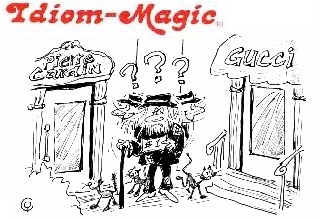
Since Fergus is usually in need, he is the ideal person to explain this saying. "It says someone in need should be grateful for what is given to him — even if it's not all he wants or expects," he said. "Once I found a purse. I returned it to its owner, of course, and was given a dollar. It wasn't much and I hoped for more, but when you are hungry, beggars can't be choosers."
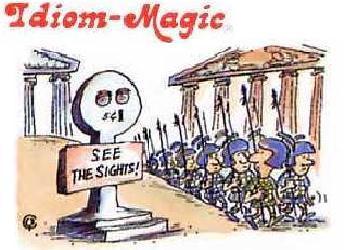
“What's that?" Marcus whispered. "It gave me pause the first time I saw it, and it’s giving me pause now!" "Oh, that thing," Antonio answered. "Don’t pay any attention to it. That's something Nero put up to squeeze a few extra pennies out of the tourists." "Wow, we have a strange emperor!" Marcus shrugged. Something that gives us pause makes us stop or hesitate a moment to think about it.
- Please post your comments and feedback --
We will try to answer all questions.
jbs & cys 亞 莊& 清 儀
About MONEY TALKS
"... slang terms, and everyday expressions associated with money have meant that whole books have been dedicated to the topic. Smithback has done an exhaustive study concerning the origin of many of these terms." From THE PHILOSOPHY OF MONEY by Professor Adrian Furnham. Pub. Routledge, 2000
About Paint The Town Red:
Sorry, Willy, but no one knows why we paint it red, not blue or yellow or pink. The expression can be traced back to sometime in the 1880s -- but no one seems to know why! Have any of you any ideas? Why not suggest an answer!
______________________________________